Little Starhorodivka
Grey BeesLittle Starhorodivka is a village in the Donbas grey zone whose abandonment makes it both a home and a front-line landscape. After the first shell strikes its church, most residents leave; by the village’s third winter of war, only Sergey Sergeyich and Pashka Khmelenko remain. Their stubborn presence sustains the possibility of return even as the war recasts the village around empty houses, blocked streets, and the sounds of fighting.
Setting and wartime geography
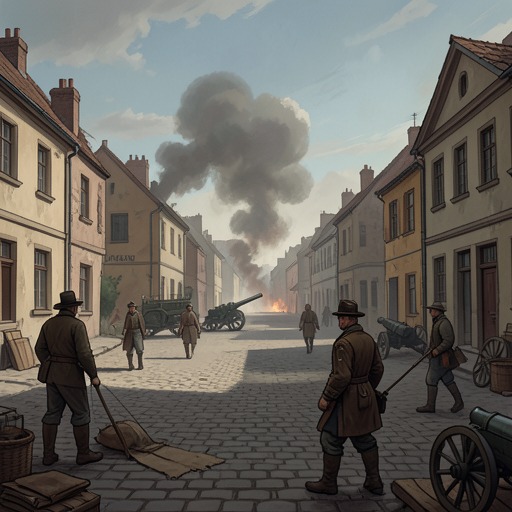
The village lies amid opposing military positions. Its two principal streets are Lenin Street and Shevchenko Street, with Ivan Michurin Lane also named among its roads. Sergeyich lives on Lenin Street; Pashka’s house, on Shevchenko Street, is a little closer to Donetsk. From Sergeyich’s garden, the land slopes toward a field and a rise near Zhdanivka, where Ukrainian troops have dug in. Beyond Pashka’s gardens and the remains of a Soviet-era apricot grove are the positions occupied by local fighters alongside Russian military personnel. The village is thus not merely near the war: its fields, gardens, and approaches sit between entrenched sides.
The broader grey zone is marked by evacuation and uncertainty. Many residents fled to Russia or elsewhere in Ukraine, while others joined the separatists. Shops, post offices, and police stations closed, and those who stayed had to reckon with shelling and shrapnel around their homes. The village’s quiet is never fully reassuring. During one winter, two weeks pass without a shot, but the pause leaves the inhabitants uncertain whether the fighting has subsided or is merely waiting to resume.
Evacuation and the two remaining residents
The first shell hits the church, and residents begin leaving the next morning. Fathers initially send their wives and children to relatives in places including Russia, Odessa, and Mykolayiv, then leave themselves; the elderly are among the last to be taken away. When Sergeyich walks the village after a night of cannon fire, he finds boarded doors and windows and a silence so striking that it makes him fear he is alone. He follows the streets toward the church, less than a kilometre from his home, and then back along Shevchenko Street. A cough from behind a fence leads him to Pashka, sitting outside with a bottle of vodka and a cigarette.
The men had been enemies since their school days and had never even exchanged greetings. Yet each refuses to abandon his home: Pashka points to his deep cellar as a refuge, while Sergeyich remains absorbed in the responsibility of caring for his bees. By the village’s third winter, their continued presence has become a shared, if unspoken, purpose. They believe that if everyone leaves, no one will return; keeping the village inhabited preserves the possibility that residents might come back when the fighting ends or the mines and shells are gone.
Mail, street names, and remnants of community
A Ukrainian-flag-coloured mail van approaches from Karuselino, two kilometres away as the crow flies and three and a half by road. Its arrival is unusual enough to seem momentarily like a promise of peace, though Sergeyich and Pashka recognize that a postal vehicle cannot stop the war. When the letters are opened, their envelopes are addressed to Lenin and Shevchenko Streets. The names no longer correspond to the village’s exchanged street signs: Lenin has become Shevchenko, and Shevchenko Lenin. The mismatch reveals how even routine connections to the outside world can arrive out of step with life on the ground.
The mail episode also places the two former school enemies in an improvised civic role. Pashka handles the bag and takes it away, saying he can use it around the house; Sergeyich responds with a knowing smile. Their quarrelsome familiarity does not erase the village’s isolation, but it gives its dwindling social world a small, practical form. Elsewhere in the novel’s remembered past, Little Starhorodivka is full of children and neighbours: when Sergeyich recalls his wife Vitalina’s first walk through the village in her red-ant dress, the neighbours watch from fences, windows, and gates, and the dress becomes village gossip. That recollection sharpens the contrast between its former sociability and the nearly emptied wartime streets.
Home, bees, and departure
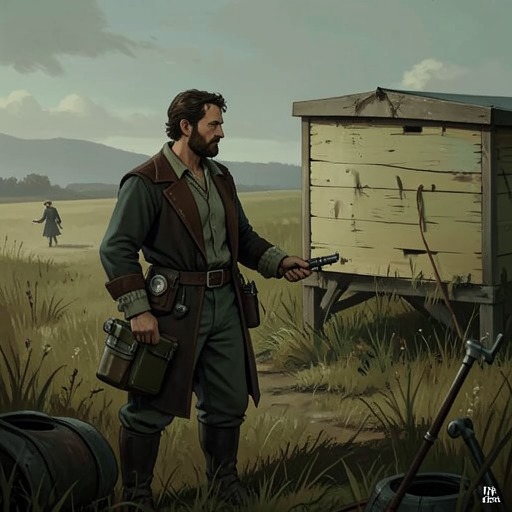
Sergeyich’s attachment to the village is inseparable from his work with bees. He regards their health as his central responsibility, while the bees’ own purpose is to gather nectar and pollen. Their activity gives order to a life in which war has become difficult for him to understand. The bond is practical as well as emotional: before leaving, he plans to close the hive entrances, load the hives onto a trailer, cover them against the rain, secure them for the road, and take jars of honey, which he thinks of as retaining value like money. Cool, rainy weather is suitable for transporting the bees because it reduces the danger of overheating inside the hives.
When Sergeyich finally drives out of Little Starhorodivka with the bees, he tells a checkpoint guard that he is from the grey zone and identifies the village by its proximity to Karuselino. His answer makes departure sound temporary rather than final: he insists that he is coming back and that he still lives there. On the way out, rain falls over the walls, trees, gates, and fences he has treated as the setting of his daily life. He realizes that he had thought he was protecting the home, when its familiar surroundings had also protected him. He entrusts Pashka with his front-door key, a practical gesture that leaves a connection to the house in the village even as the apiary travels on.
The novel later returns Sergeyich to the road home. Outside Melitopol, he passes a military convoy coming back from the war and distinguishes its journey from his own: he is going home, though his home lies inside the war. He reasons that the village has remained standing because no one fires on the enemy from his yard, windows, or fence. In a dream during the journey, however, grey, camouflage-clad bees emerge from a hive and move toward Little Starhorodivka as if on a military mission. The image unsettles his sense that the bees belong to a life organized around work and nature, rather than military purposes.
Narrative significance
Little Starhorodivka concentrates the novel’s attention on civilians who remain in a conflict zone rather than on military operations or heroic soldiers. Its two holdouts embody different forms of persistence: Pashka stays with his cellar and the resources of his house, while Sergeyich’s sense of responsibility is focused on his apiary. Their continued presence is modest, not triumphant, but it keeps open the future tense of the village—the expectation that someone may return.
The place also gives physical shape to war’s normalization. Front lines, trenches, abandoned fields, and closed institutions become parts of the surroundings in which the residents continue to tend homes, exchange mail, and care for bees. Sergeyich’s departure with the hives does not settle whether he will return or whether the village can recover. Instead, his claim that he is coming back holds together the tension at the heart of Little Starhorodivka: it is still home, but home has become a place one must leave in order to keep living.